
Global Air Water Generation Initiative
Global Air Water Generation Initiative
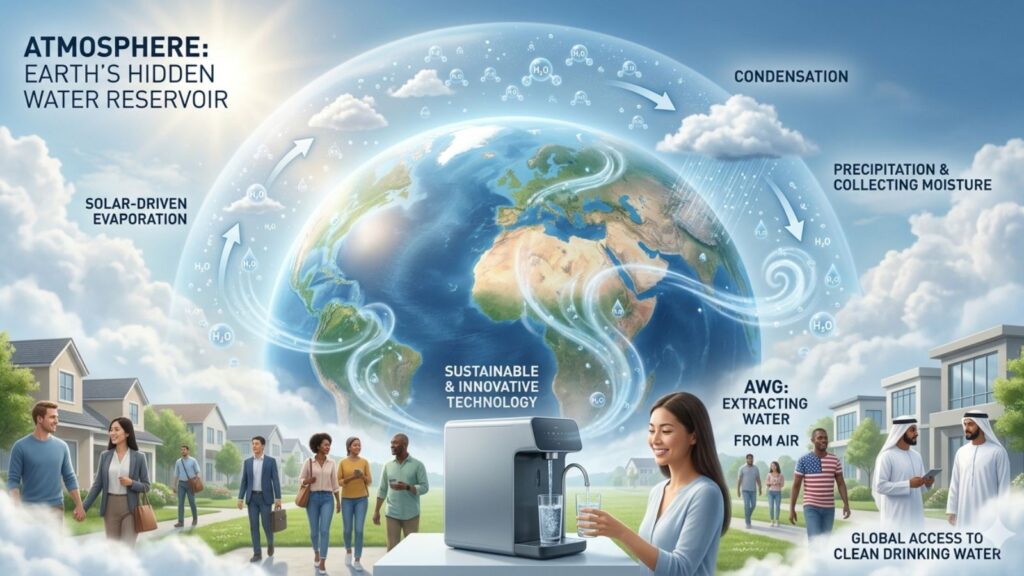
The Earth’s atmosphere contains an estimated 12,900 cubic kilometres of water in vapour form – more than all the world’s rivers combined. This water is clean, constantly renewed by the global water cycle, and present above every community on the planet.
Atmospheric Water Generation (AWG) captures this moisture and converts it into clean, safe, potable water – without rivers, lakes, aquifers, pipelines, or desalination plants. By engineering the natural process of dew formation, AWG systems draw in ambient air, extract its moisture, and purify it to WHO drinking water standards.
As of 2025, over 1.5 million governmental AWG units are deployed across more than 160 nations, generating an estimated 2 billion litres of clean water daily. The global AWG market, valued at USD 2.8 billion in 2024, is projected to reach USD 6.1 billion by 2034.
The most widely deployed AWG method, accounting for ~80% of the global market. Ambient air is drawn over refrigerant-chilled coils cooled below the local dew point (typically 10–20°C), causing water vapour to condense into liquid droplets – much like moisture forming on the outside of a cold glass on a humid day.
The condensed water passes through rigorous multi-stage purification:
Humid environments (40–100% relative humidity).
300–600 Wh/L
Watergen GEN-350, delivering 600 litres/day in Navajo communities, Arizona.
Desiccant-based AWG uses hygroscopic materials – silica gel, zeolites, lithium chloride, and advanced metal-organic frameworks (MOFs) – to absorb water vapour from the air even at low humidity. Once saturated, the sorbent is heated (typically by solar energy at 60–100°C) to release captured moisture as pure steam, which is then condensed and purified.
The latest sorbent-based systems can yield 5.8 litres per kilogram of sorbent per day at just 30% relative humidity – a breakthrough that is rapidly extending AWG viability into arid regions.
Arid environments (15–60% RH). Energy use: 200–400 Wh/L
200–400 Wh/L
SOURCE Hydropanels, deployed in remote schools and homes globally.
The latest generation of AWG combines both approaches with renewable energy integration. Desiccants pre-concentrate atmospheric moisture, which a more efficient cooling stage then processes – reducing energy consumption by up to 40–45%, enabling operation across a far wider range of humidity conditions (20–100% RH), and achieving the lowest carbon footprint of any AWG approach.
Variable climates; large-scale municipal and industrial applications.
150–350 Wh/L
Watergen GEN-350, delivering 600 litres/day in Navajo communities, Arizona.
| Feature | Cooling-Condensation | Desiccant Absorption | Hybrid Systems |
|---|---|---|---|
| Optimal Humidity | 40–100% RH | 15–60% RH | 20–100% RH |
| Energy Use (Wh/L) | 300–600 | 200–400 | 150–350 |
| Daily Yield (per kW) | 2–5 L | 3–6 L | 4–8 L |
| Cost per Litre (USD) | 0.02–0.10 | 0.05–0.20 | 0.01–0.08 |
| Leading Example | Watergen GEN-350 | SOURCE Hydropanel | GENAQ AT-1000 |
| Carbon Footprint | Moderate | Low | Lowest |
1.5 million governmental AWG units deployed across 160+ countries
2 billion litres of AWG water generated every day
30% year-on-year growth in governmental AWG deployments
AWG offsets 15% of urban water abstraction in pilot regions
Energy efficiency improved by up to 50% since 2020
AWG averts an estimated 2 million tonnes of plastic waste annually
By 2030, AI-optimised AWG control systems are projected to boost yields by a further 30%.

© 2026 Global Air Water Generation Initiative. All rights reserved.